

SENIOR CITIZENS OF PATAGONIA
2025
Title VI Contact: Charles R. Kelly Secretary/Treasurer
Title VI Contact Phone: 520-394-2494
Title VI Contact Email: user1scp@gmail.com
Alternate Language Phone: 520-394-2494
Address: PO Box 1121, 100 Quiroga Ln Patagonia, AZ 85624
Web Address: seniorcitizensofpatagonia.org
Para Información en Español: Juan Urias 520-394-2494
Title VI Plan Table of Contents
Title VI Plan Table of Contents. 2
Non Discrimination Notice to the Public. 4
Non Discrimination Notice to the Public – Spanish. 5
Non Discrimination ADA/Title VI Complaint Procedures. 7
Discrimination ADA/Title VI Complaint Form.. 8
Discrimination ADA/Title VI Investigations, Complaints, and Lawsuits. 11
Limited English Proficiency Plan. 12
Non-elected Committees Membership Table. 17
Monitoring for Subrecipient Title VI Compliance. 17
Fixed Route Transit Provider Analysis. 18
Board Approval for the Title VI Plan. 18
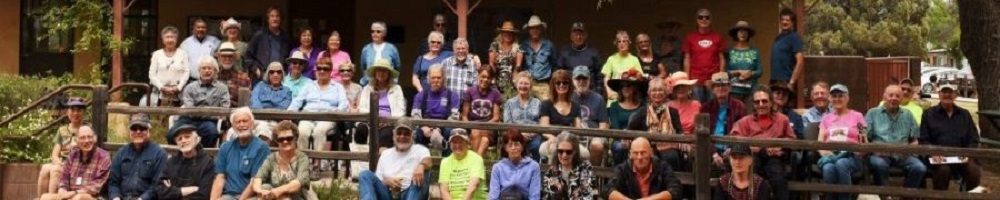
Senior Citizens of Patagonia is a 501 (c) (3) non profit organization, incorporated in 1989. Our mission is to provide hot and nutritious meals and transportation five days a week to senior citizens and people with disabilities who live in the Patagonia, Sonoita, Elgin and Canelo districts, and to transport senior citizens and people with disabilities to hospitals, medical and dental visits, the airport and shopping. We started our transportation services for our senior citizens and people with disabilities living in Patagonia, Sonoita and Elgin to hospitals, doctor visits, the airport and shopping, in 2003, and we have four vehicles and all volunteer drivers. In 2014 we also began to provide meals five days a week to our clientele. All our services are on a donation-only basis. To continue the sustainability of our organization, in 2018 we created an Endowment Fund with the Raymond James Financial Group.
ADA complaints
As required by the Americans with Disabilities Act (ADA),
discrimination related customer service complaints, including those associated
with ADA regulations, are reported to ADOT Civil Rights Office and complaint
documentation is maintained on file for one year. ADA related service complaint logs are kept
on file for five years, according to USDOT regulations.
What type of program fund(s) did you apply for?
☒ 5310
Type of Funding Requests? (Check all that apply)
☒ Operating Funds
☒ Other (please explain) Preventive Maintenance
Is your agency a direct recipient of FTA funds?
☒No
Non Discrimination Notice to the Public
Notifying the Public of Rights Under Title VI and ADA
SENIOR CITIZENS OF PATAGONIA
SENIOR CITIZENS OF PATAGONIA operates its programs and services without regard to race, color, national origin or disability in accordance with Title VI of the Civil Rights Act of 1964, Section 504 of the Rehabilitation Act of 1973, and the Americans with Disabilities Act of 1990 (ADA). Any person who believes she or he has been aggrieved by any unlawful discriminatory practice under Title VI may file a complaint with the SENIOR CITIZENS OF PATAGONIA.
For more information on the SENIOR CITIZENS OF PATAGONIA’s civil rights program, and the procedures to file a complaint, contact; email user1scp@gmail.com; or visit our administrative office at PO Box 1121, 100 Quiroga Ln Patagonia, AZ 85624. For more information, visit https://seniorcitizensofpatagonia.org/
Complaints may be filed directly with the Arizona Department of Transportation (ADOT) Civil Rights Office. ATTN: Title VI Program Coordinator 206 S. 17TH Ave MD 155A RM: 183 Phoenix AZ, 85007 or with the Federal Transit Administration (FTA). ATTN: Title VI Program Coordinator, 1200 New Jersey Ave., SE Washington DC 20590
If information is needed in another language, contact 520-394-2494. *Para información en Español llame: Juan Urias 520-394-2494
The above notice is posted online at – seniorcitizensofpatagonia.org
Non Discrimination Notice to the Public – Spanish
Aviso Público Sobre los Derechos Bajo el Título VI Y ADA
SENIOR CITIZENS OF PATAGONIA
SENIOR CITIZENS OF PATAGONIA (y sus subcontratistas, si cualquiera) asegura cumplir con el Título VI de la Ley de los Derechos Civiles de 1964, Sección 504 de la Ley de Rehabilitación de 1973 y La Ley de ciudadanos Americanos con Discapacidades de 1990 (ADA). El nivel y la calidad de servicios de transporte serán proveídos sin consideración a su raza, color, país de origen, o discapacidad.
Para obtener más información sobre el programa de Derechos Civiles de SENIOR CITIZENS OF PATAGONIA, y los procedimientos para presentar una queja, contacte Charles R. Kelly Secretary/Treasurer; o visite nuestra oficina administrativa en PO Box 1121, 100 Quiroga Ln Patagonia, AZ 85624. Para obtener más información, visite https://seniorcitizensofpatagonia.org/
Una queja puede ser presentada con la oficina de Derechos Civiles del Departamento de Transporte de Arizona (ADOT). Atención: Title VI Program Manager, 206 S. 17th Ave MD 155A Phoenix AZ, 85007 o con la Administración Federal de Transporte (FTA). Atención: Title VI Coordinator, 1200 New Jersey Ave., SE Washington DC 20590
The above notice is posted in the following locations:
This notice is posted online at https://seniorcitizensofpatagonia.org/ and in the Patagonia Senior Center
Non Discrimination ADA/Title VI Complaint Procedures
These procedures provide guidance for all complaints filed under Title VI of the Civil Rights Act of 1964, Section 504 of the Rehabilitation Act of 1973, and the Americans with Disabilities Act of 1990 (ADA) as they relate to any program or activity that is administered by SENIOR CITIZENS OF PATAGONIA including consultants, contractors and vendors. Intimidation or retaliation as a result of a complaint is prohibited by law. In addition to these procedures, complainants reserve the right to file a formal complaint with other State or Federal agencies or to seek private counsel for complaints alleging discrimination. Every effort will be made to resolve complaints at the lowest possible level.
Wheelchair
Securement and Equivalent Service
As required by the Americans with Disabilities Act (ADA),
Senior Citizens of Patagonia, Inc. has two wheelchair accessible vehicles in
our fleet of three vans to ensure that persons needing a wheelchair have
equivalent access to our transportation services as ambulatory persons. Our
volunteer drivers are familiarized with the securement of wheelchairs as part
of their overall training program. There is also a diagram in each vehicle
which shows the proper manner of securing a wheelchair.
Sensitivity to
Passengers
As part of the training of our volunteer drivers, we provide
information so that they can identify disability and functional limitations of
disabled passengers, as well as to gain a level of comfort around issues of
disability, including appropriate etiquette. Should any passenger feel they are
discriminated against because of their disability, a complaint procedure is
also posted in each vehicle.
Effective
Communication
As required by the Americans with Disabilities Act (ADA),
Senior Citizens of Patagonia, Inc. trains its volunteer drivers to become familiar
with the basic rights of persons with disabilities. Knowing their rights
ensures that communication will be sensitive as well as effective, ensuring
that our disabled passengers get the right service at the right time and in the
right manner.
Maintenance of Accessible Features on Vehicles
As required by the Americans with Disabilities Act (ADA),
Senior Citizens of Patagonia, Incorporated makes sure that the accessible
features on our vehicles are maintained in operative condition so that
individuals needing these features receive equivalent service to individuals
not needing those features.
Accessibility features are repaired promptly if they are damaged or out
of order. Drivers are required to report
lift and ramp failures promptly.
Adequate Time for Vehicle
As required by the Americans with Disabilities Act (ADA),
Senior Citizens of Patagonia, Incorporated provides adequate time for boarding
and disembarking our vehicles for individuals with disabilities.
Use of Portable Oxygen/Respirator Equipment
As required by the Americans with Disabilities Act (ADA),
individuals using our transportation service may bring respirator, portable
oxygen equipment, and/or other life support equipment on board our vehicles, if
they do not violate the law or rules relating to the transportation of
hazardous materials. All equipment must
be small enough to fit into our vehicles safely and without obstructing the
aisle and/or blocking
Service Animals
As required by the Americans with Disabilities Act (ADA),
any guide dog, signal dogs, or other animal individually trained to work or
perform tasks for the benefit of an individual with a disability, including but
not limited to, guiding individuals with impaired vision or alerting
individuals with impaired hearing, have access to our vehicles. All service animals must be always kept under
the control of their owner and abide by local animal safety regulations.
Driver use of, and assistance with, accessibility Equipment
As required by the Americans with Disabilities Act (ADA),
personnel make use of all available accessibility equipment when needed and
provide a reasonable level of assistance to passengers as necessary and upon
request with lifts, ramps, and securement devices.
ADA complaints
As required by the Americans with Disabilities Act (ADA),
discrimination related customer service complaints, including those associated
with ADA regulations, are reported to ADOT Civil Rights Office and complaint
documentation is maintained on file for one year. ADA related service complaint logs are kept
on file for five years, according to USDOT regulations.
If information is needed in another language, contact 520-394-2494. *Para información en Español llame: Juan Urias 520-394-2494
| Section I: | |||||
| Name: | |||||
| Address: | |||||
| Telephone (Home): | Telephone (Work): | ||||
| Electronic Mail Address: | |||||
| Accessible Format Requirements? | ☐ Large Print | ☐ Audio Tape | |||
| ☐ TDD | ☐ Other | ||||
| Section II: | |||||
| Are you filing this complaint on your own behalf? | ☐ Yes* | ☐ No | |||
| *If you answered “yes” to this question, go to Section III. | |||||
| If not, please supply the name and relationship of the person for whom you are complaining. | |||||
| Please explain why you have filed for a third party: | |||||
| Please confirm that you have obtained the permission of the aggrieved party if you are filing on behalf of a third party. | ☐ Yes | ☐ No | |||
| Section III: | |||||
| I believe the discrimination I experienced was based on (check all that apply):
☐ Race ☐ Color ☐ National Origin ☐ Disability Date of Alleged Discrimination (Month, Day, Year): Explain as clearly as possible what happened and why you believe you were discriminated against. Describe all persons who were involved. Include the name and contact information of the person(s) who discriminated against you (if known) as well as names and contact information of any witnesses. If more space is needed, please use the back of this form. |
|||||
| Section VI: | |||||
| Have you previously filed a Discrimination Complaint with this agency? | ☐ Yes | ☐ No | |||
| If yes, please provide any reference information regarding your previous complaint. | |||||
| Section V: | |||||
| Have you filed this complaint with any other Federal, State, or local agency, or with any Federal or State court?☐ Yes ☐ No
If yes, check all that apply: ☐ Federal Agency: ☐ Federal Court: ☐ State Agency: ☐ State Court : ☐ Local Agency: |
|||||
| Please provide information about a contact person at the agency/court where the complaint was filed. | |||||
| Name: | |||||
| Title: | |||||
| Agency: | |||||
| Address: | |||||
| Telephone: | |||||
| Section VI: | |||||
| Name of agency complaint is against: | |||||
| Name of person complaint is against: | |||||
| Title: | |||||
| Location: | |||||
| Telephone Number (if available): | |||||
You may attach any written materials or other information that you think is relevant to your complaint. Your signature and date are required below:
Signature Date
Please submit this form in person at the address below, or mail this form to:
SENIOR CITIZENS OF PATAGONIA
Charles R. Kelly Secretary/Treasurer
PO Box 1121, 100 Quiroga Ln Patagonia, AZ 85624
520-394-2494
user1scp@gmail.com
A copy of this form can be found online at https://seniorcitizensofpatagonia.org/
If information is needed in another language, contact 520-394-2494. *Para información en Español llame: Juan Urias 520-394-2494
Discrimination ADA/Title VI Investigations, Complaints, and Lawsuits
If no investigations, lawsuits, or complaints were filed select the option below.
☒ SENIOR CITIZENS OF PATAGONIA has not had any ADA nor Title VI Discrimination complaints, investigations, or lawsuits in 2024.
| Complainant | Date (Month, Day, Year) | Basis of Complaint (Race, Color, National Origin or Disability) | Summary of Allegation | Status | Action(s) Taken | Final Findings? |
| Investigations | ||||||
| 1) | ||||||
| 2) | ||||||
| Lawsuits | ||||||
| 1) | ||||||
| 2) | ||||||
| Complaints | ||||||
| 1) | ||||||
| 2) |
SENIOR CITIZENS OF PATAGONIA is engaging the public in its planning and decision-making processes, as well as its marketing and outreach activities. The public will be invited to participate in the process whether through public meetings or surveys.
As an agency receiving federal financial assistance, SENIOR CITIZENS OF PATAGONIA made the following community outreach efforts and activities to engage minority and Limited English Proficient populations since the last Title VI Plan submittal to ADOT CRO.
☒ Advertised public announcements through newspapers, fliers, or radio
☒ Posted the Nondiscrimination Public Notices to the following locations:
☒ Within transportation vehicles
☒ Lobby of agency
☒ Partnered with other local agencies to advertise services provided
SENIOR CITIZENS OF PATAGONIA will make the following community outreach efforts for the upcoming year:
☒ Advertise public announcements through newspapers, fliers, or radio
☒ Post the Nondiscrimination Public Notices to the following locations:
☒ Within transportation vehicles
☒ Lobby of agency
☒ Partner with other local agencies to advertise services provided.
PATAGONIA REGIONAL TIMES
The Senior Center has three vans to bring seniors and people with disabilities to medical appointments and shopping. In 2020, volunteer drivers drove 36,242 miles with 504 clients and 1,728 driver hours. Anyone interested in being a volunteer driver are encouraged to contact the Senior Center. Those needing rides can also call the center. Patra Kelly, spokeswoman for the transportation program, suggests scheduling morning and early afternoon appointments so that drivers will not be on the road after dark. Our daily lunch program served 8,641 meals in 2020. The program relies strongly upon our diners’ donations to help fund this program, as only half the necessary money come from South East Arizona Governments Organization (SEAGO). The Board of Directors held its annual meeting on January 11th, 2021. Board members are Irene Smith (President), Helen Chester (Vice President), Chuck Kelly (Secretary/Treasurer), Ray Klein, Philp Brister, John Urias, Jon Larsen and Patra Kelly, Directors
Limited English Proficiency Plan
SENIOR CITIZENS OF PATAGONIA has developed the following Limited English Proficiency Plan (LEP) to help identify reasonable steps to provide language assistance for LEP persons seeking meaningful access to SENIOR CITIZENS OF PATAGONIA services as required by Executive Order 13166. A Limited English Proficiency person is one who does not speak English as their primary language and who has a limited ability to read, speak, write, or understand English.
This plan details procedures on how to identify a person who may need language assistance, the ways in which assistance may be provided, training to staff, notification to LEP persons that assistance is available, and information for future plan updates. In developing the plan while determining the SENIOR CITIZENS OF PATAGONIA’s extent of obligation to provide LEP services, the SENIOR CITIZENS OF PATAGONIA undertook a U.S. Department of Transportation four-factor LEP analysis which considers the following:
| Arizona | Santa Cruz CDP, Arizona | |||
| Label | Estimate | Margin of Error | Estimate | Margin of Error |
| Total: | 6,510,583 | ±302 | 0 | ±12 |
| Speak only English | 4,740,041 | ±9,965 | 0 | ±12 |
| Spanish: | 1,338,389 | ±8,106 | 0 | ±12 |
| Speak English “very well” | 891,122 | ±7,150 | 0 | ±12 |
| Speak English less than “very well” | 447,267 | ±5,315 | 0 | ±12 |
| French, Haitian, or Cajun: | 17,597 | ±1,187 | 0 | ±12 |
| Speak English “very well” | 13,920 | ±1,001 | 0 | ±12 |
| Speak English less than “very well” | 3,677 | ±527 | 0 | ±12 |
| German or other West Germanic languages: | 23,083 | ±1,250 | 0 | ±12 |
| Speak English “very well” | 20,639 | ±1,133 | 0 | ±12 |
| Speak English less than “very well” | 2,444 | ±377 | 0 | ±12 |
| Russian, Polish, or other Slavic languages: | 24,054 | ±1,670 | 0 | ±12 |
| Speak English “very well” | 16,496 | ±1,196 | 0 | ±12 |
| Speak English less than “very well” | 7,558 | ±841 | 0 | ±12 |
| Other Indo-European languages: | 64,572 | ±2,981 | 0 | ±12 |
| Speak English “very well” | 48,330 | ±2,290 | 0 | ±12 |
| Speak English less than “very well” | 16,242 | ±1,475 | 0 | ±12 |
| Korean: | 9,983 | ±950 | 0 | ±12 |
| Speak English “very well” | 5,206 | ±668 | 0 | ±12 |
| Speak English less than “very well” | 4,777 | ±603 | 0 | ±12 |
| Chinese (incl. Mandarin, Cantonese): | 34,917 | ±1,692 | 0 | ±12 |
| Speak English “very well” | 17,477 | ±1,159 | 0 | ±12 |
| Speak English less than “very well” | 17,440 | ±1,234 | 0 | ±12 |
| Vietnamese: | 23,792 | ±1,680 | 0 | ±12 |
| Speak English “very well” | 10,097 | ±915 | 0 | ±12 |
| Speak English less than “very well” | 13,695 | ±1,262 | 0 | ±12 |
| Tagalog (incl. Filipino): | 26,633 | ±1,722 | 0 | ±12 |
| Speak English “very well” | 19,813 | ±1,357 | 0 | ±12 |
| Speak English less than “very well” | 6,820 | ±840 | 0 | ±12 |
| Other Asian and Pacific Island languages: | 40,891 | ±2,050 | 0 | ±12 |
| Speak English “very well” | 28,521 | ±1,594 | 0 | ±12 |
| Speak English less than “very well” | 12,370 | ±984 | 0 | ±12 |
| Arabic: | 25,342 | ±2,187 | 0 | ±12 |
| Speak English “very well” | 15,606 | ±1,598 | 0 | ±12 |
| Speak English less than “very well” | 9,736 | ±1,093 | 0 | ±12 |
| Other and unspecified languages: | 141,289 | ±2,922 | 0 | ±12 |
| Speak English “very well” | 106,312 | ±2,416 | 0 | ±12 |
| Speak English less than “very well” | 34,977 | ±1,696 | 0 | ±12 |
SENIOR CITIZENS OF PATAGONIA’s staff reviewed the frequency with which office staff, dispatchers and drivers have, or could have, contact with LEP persons for 2024 . SENIOR CITIZENS OF PATAGONIA averages 5contacts per month.
It is our aim to meet all our clients’ needs, regardless of their language ability. Should there be anyone unable to communicate in English or Spanish, we will make every effort to comply with their requirements, as this is an integral part of our mission statement.
SENIOR CITIZENS OF PATAGONIA provides a statement in Spanish and will for additional languages specific to the LEP community make up that will be included in all public outreach notices. Every effort will be made to provide vital information to LEP individuals in the language requested.
Safe Harbor Provision for written translations
SENIOR CITIZENS OF PATAGONIA complies with the Safe Harbor Provision, as evidenced by the number of documents available in the Spanish language. With respect to Title VI information, the following shall be made available in Spanish:
In addition, we will conduct our marketing (including using translated materials) in a manner that reaches each LEP group. Vital documents include the following:
1) SENIOR CITIZENS OF PATAGONIA provides language assistance services through the below methods:
Staff is provided a list of what written and oral language assistance products and methods the agency has implemented and how agency staff can obtain those services.
☒ Instructions are provided to customer service staff and other SENIOR CITIZENS OF PATAGONIA staff who regularly take phone calls from the general public on how to respond to an LEP caller.
☒ Instructions are provided to customer service staff and others who regularly respond to written communication from the public on how to respond to written communication from an LEP person.
☒ Instructions are provided to vehicle operators, station managers, and others who regularly interact with the public on how to respond to an LEP customer.
2) SENIOR CITIZENS OF PATAGONIA has a process to ensure the competency of interpreters and translation service through the following methods:
SENIOR CITIZENS OF PATAGONIA will ask the interpreter or translator to demonstrate that he or she can communicate or translate information accurately in both English and the other language. SENIOR CITIZENS OF PATAGONIA will train the interpreter or translator in specialized terms and concepts associated with the agency’s policies and activities. SENIOR CITIZENS OF PATAGONIA will instruct the interpreter or translator that he or she should not deviate into a role as counselor, legal advisor, or any other role aside from interpreting or translator. SENIOR CITIZENS OF PATAGONIA will ask the interpreter or translator to attest that he or she does not have a conflict of interest on the issues that they would be providing interpretation services.
3) SENIOR CITIZENS OF PATAGONIA provides notice to LEP persons about the availability of language assistance through the following methods:
☒ Statements in outreach documents that language services are available from the agency.
☒ Working with community-based organizations and other stakeholders to inform LEP individuals of the Recipients’ services, including the availability of language assistance services
☒ Announcements at community meetings
☒ Signs and handouts available in vehicles
☒ Agency websites
4) SENIOR CITIZENS OF PATAGONIA monitors, evaluates and updates the LEP plan through the following process:
SENIOR CITIZENS OF PATAGONIA will monitor the LEP plan by conducting an annual Four-Factor analysis, establishing a process to obtain feedback from internal staff and members of the public and conducting internal evaluations to determine whether the language assistance measures are working for staff. SENIOR CITIZENS OF PATAGONIA will make changes to the language assistance plan based on feedback received. SENIOR CITIZENS OF PATAGONIA may take into account the cost of proposed changes and the resources available to them. Depending on the evaluation, SENIOR CITIZENS OF PATAGONIA may choose to disseminate more widely those language assistance measures that are particularly effective or modify or eliminate those measures that have not been effective. SENIOR CITIZENS OF PATAGONIA will consider new language assistance needs when expanding transit service into areas with high concentrations of LEP persons will consider modifying their implementation plan to provide language assistance measures to areas not previously served by the agency.
5) SENIOR CITIZENS OF PATAGONIA trains employees to know their obligations to provide meaningful access to information and services for LEP persons and all employees in public contact positions will be properly trained to work effectively with in-person and telephone interpreters. SENIOR CITIZENS OF PATAGONIA will implement processes for training of staff through the following procedures:
SENIOR CITIZENS OF PATAGONIA will identify staff that are likely to come into contact with LEP persons as well as management staff that have frequent contact with LEP persons in order to target training to the appropriate staff. SENIOR CITIZENS OF PATAGONIA will identify existing staff training opportunities, as it may be cost-effective to integrate training on their responsibilities to persons with limited English proficiency into agency training that occurs on an ongoing basis. SENIOR CITIZENS OF PATAGONIA will include this training as part of the orientation for new employees. Existing employees, especially managers and those who work with the public may periodically take part in re-training or new training sessions to keep up to date on their responsibilities to LEP persons. SENIOR CITIZENS OF PATAGONIA will implement LEP training to be provided for agency staff. SENIOR CITIZENS OF PATAGONIA staff training for LEP to include:
LIMITED ENGLISH PROFICIENCY PLAN
It is not frequent that Limited English Proficiency individuals come in contact with Senior Citizens of Patagonia’s services. Since our population is not greatly increasing, the number of LEP citizens is not expected to grow very much. An account in both English and Spanish, detailing our available services, is posted on our website: seniorcitizensofpatagonia.org in an effort to communicate to potential LEP clients and others. This is our primary method of reaching our population, including those who communicate only in Spanish. Many of our lunch-goers and van drivers are bilingual, so language barriers are seldom a problem. Our budget includes funds earmarked for distribution of bilingual communications to our population. If anyone knows of an LEP person needing our services and requiring assistance, please inform one of our Board of Directors
Non-elected Committees Membership Table
Subrecipients who select the membership of transit-related, non-elected planning boards, advisory councils, or committees must provide a table depicting the membership of those organizations broken down by race. Subrecipients also must include a description of the efforts made to encourage participation of minorities on these boards, councils, and committees.
☒ SENIOR CITIZENS OF PATAGONIA does not select the membership of any transit-related committees, planning boards, or advisory councils.
Monitoring for Subrecipient Title VI Compliance
Describe how you monitor your subrecipients. This can be through site visits, submissions of Title VI Plans annually, or training and surveys.
☒ SENIOR CITIZENS OF PATAGONIA does not monitor subrecipients for Title VI compliance.
A subrecipient planning to acquire land to construct certain types of facilities must not discriminate on the basis of race, color, or national origin, against persons who may, as a result of the construction, be displaced from their homes or businesses. “Facilities” in this context does not include transit stations or bus shelters, but instead refers to storage facilities, maintenance facilities, and operation centers.
There are many steps involved in the planning process prior to the actual construction of a facility. It is during these planning phases that attention needs to be paid to equity and non-discrimination through equity analysis. The Title VI Equity Analysis must be done before the selection of the preferred site.
Note: Even if facility construction is financed with non-FTA funds, if the subrecipient organization receives any FTA dollars, it must comply with this requirement.
☒ SENIOR CITIZENS OF PATAGONIA has no current or anticipated plans to develop new transit facilities covered by these requirements
Fixed Route Transit Provider Analysis
Fixed Route: Public transit service (other than by aircraft) provided on a repetitive, fixed-schedule basis along a specific route, with vehicles stopping to pick up passengers.
A subrecipient providing fixed route service, as defined above, must determine the distribution of transit amenities or the vehicle assignments for each mode in a non-discriminatory manner. The subrecipient must develop policies to ensure service is not distributed on the basis of race, color, or national origin.
Effective practices to fulfill the Service Standards requirements include developing written policies covering each of the following service indicators: [INSTRUCTIONS] (can be expressed in writing or in table format – see Circular Appendix G & H pp. 87-91)
☒ SENIOR CITIZENS OF PATAGONIA is not a Fixed Route Transit Provider
To qualify for the two-year contract of 2025-26 with ADOT, the Board of Directors
of Senior Citizens of Patagonia,Inc.agrees to the Title VI Implementation Plan and approves the following:
The Board of Directors of Senior Citizens of Patagonia, Inc. agrees to all
the provisions of the Civil Rights Act of 1964, Section 504 of the Rehabilitation Act of 1973, and the Americans with Disabilities Act of 1990 (ADA), operating its programs and services without regard to race, color, national origin or disability. It approves and agrees with the Title VI Civil Rights document as submitted on the ADOT 5310 application cycle for the years 2025-2026, and
as listed on our website.
Helen Chester- President Date
Senior Citizens of Patagonia Inc. is a non-profit 501(c)3 organization and recognized by the State of Arizona as a Qualified Charitable Organization. Talk to your tax advisor on how your contribution may reduce your tax liability. (Tax ID # 86-0458778)
Citizens of Patagonia, Inc. ADA Policies 2025
It is the policy of the Senior Citizens of Patagonia, Inc. to abide by all provisions of
the Americans with Disabilities Act (ADA) of 1990, as amended, including but
not limited to those stated below, in all activities, operations and
relationships with and accommodations of employees, client-customers, and the general public.
The Americans
with Disabilities Act of 1990 (ADA) requires that individuals with disabilities
receive the same level of service as non-disabled individuals. Services that
are “separate but equal” are not acceptable (i.e. all individuals using wheelchairs
on one bus and everyone else on another bus).
We recognize
that we must keep federally funded equipment and facilities in good operating
condition, and that we must have policies and procedures to maintain our vehicles.
We maintain, in operative condition, those features of facilities, vehicles,
and other capital equipment that are required to make them accessible. ADA
accessibility features are repaired promptly if they are damaged or out of
order. We have established a system of regular and frequent maintenance checks
of lifts sufficient to determine if they are operative.
Wheelchair
Securement and Equivalent Service
As required by the Americans with Disabilities Act (ADA),
Senior Citizens of Patagonia, Inc. has two wheelchair accessible vehicles in
our fleet of three vans to ensure that persons needing a wheelchair have
equivalent access to our transportation services as ambulatory persons. Our
volunteer drivers are familiarized with the securement of wheelchairs as part
of their overall training program. There is also a diagram in each vehicle
which shows the proper manner of securing a wheelchair.
Sensitivity to
Passengers
As part of the training of our volunteer drivers, we provide
information so that they can identify disability and functional limitations of
disabled passengers, as well as to gain a level of comfort around issues of
disability, including appropriate etiquette. Should any passenger feel they are
discriminated against because of their disability, a complaint procedure is
also posted in each vehicle.
Effective
Communication
As required by the Americans with Disabilities Act (ADA),
Senior Citizens of Patagonia, Inc. trains its volunteer drivers to become familiar
with the basic rights of persons with disabilities. Knowing their rights
ensures that communication will be sensitive as well as effective, ensuring
that our disabled passengers get the right service at the right time and in the
right manner.
Maintenance of Accessible Features on Vehicles
As required by the Americans with Disabilities Act (ADA),
Senior Citizens of Patagonia, Incorporated makes sure that the accessible
features on our vehicles are maintained in operative condition so that
individuals needing these features receive equivalent service to individuals
not needing those features.
Accessibility features are repaired promptly if they are damaged or out
of order. Drivers are required to report
lift and ramp failures promptly.
Adequate Time for Vehicle
As required by the Americans with Disabilities Act (ADA),
Senior Citizens of Patagonia, Incorporated provides adequate time for boarding
and disembarking our vehicles for individuals with disabilities.
Use of Portable Oxygen/Respirator Equipment
As required by the Americans with Disabilities Act (ADA),
individuals using our transportation service may bring respirator, portable
oxygen equipment, and/or other life support equipment on board our vehicles, if
they do not violate the law or rules relating to the transportation of
hazardous materials. All equipment must
be small enough to fit into our vehicles safely and without obstructing the
aisle and/or blocking
Service Animals
As required by the Americans with Disabilities Act (ADA),
any guide dog, signal dogs, or other animal individually trained to work or
perform tasks for the benefit of an individual with a disability, including but
not limited to, guiding individuals with impaired vision or alerting
individuals with impaired hearing, have access to our vehicles. All service animals must be always kept under
the control of their owner and abide by local animal safety regulations.
Driver use of, and assistance with, accessibility Equipment
As required by the Americans with Disabilities Act (ADA),
personnel make use of all available accessibility equipment when needed and
provide a reasonable level of assistance to passengers as necessary and upon
request with lifts, ramps, and securement devices.
ADA complaints
As required by the Americans with Disabilities Act (ADA),
discrimination related customer service complaints, including those associated
with ADA regulations, are reported to ADOT Civil Rights Office and complaint
documentation is maintained on file for one year. ADA related service complaint logs are kept
on file for five years, according to USDOT regulations.
Information needed in Spanish please contact Juan Urias 520-394-2494
Para Información en Español
por favor de hablar con Juan Urias 520-394-2494
This resource guide is provided by the Legacy Foundation of Southern Arizona and contains a listing of all of the health and wellness organizations available in our local community. We hope you use this resource guide to find the services you need to help yourself and others.
https://legacyfoundationresourceguide.org/home
This Resource Guide does not provide medical advice. If you believe you are having a medical emergency, call 911 immediately.
SENIOR CITIZENS OF PATAGONIA, INC.
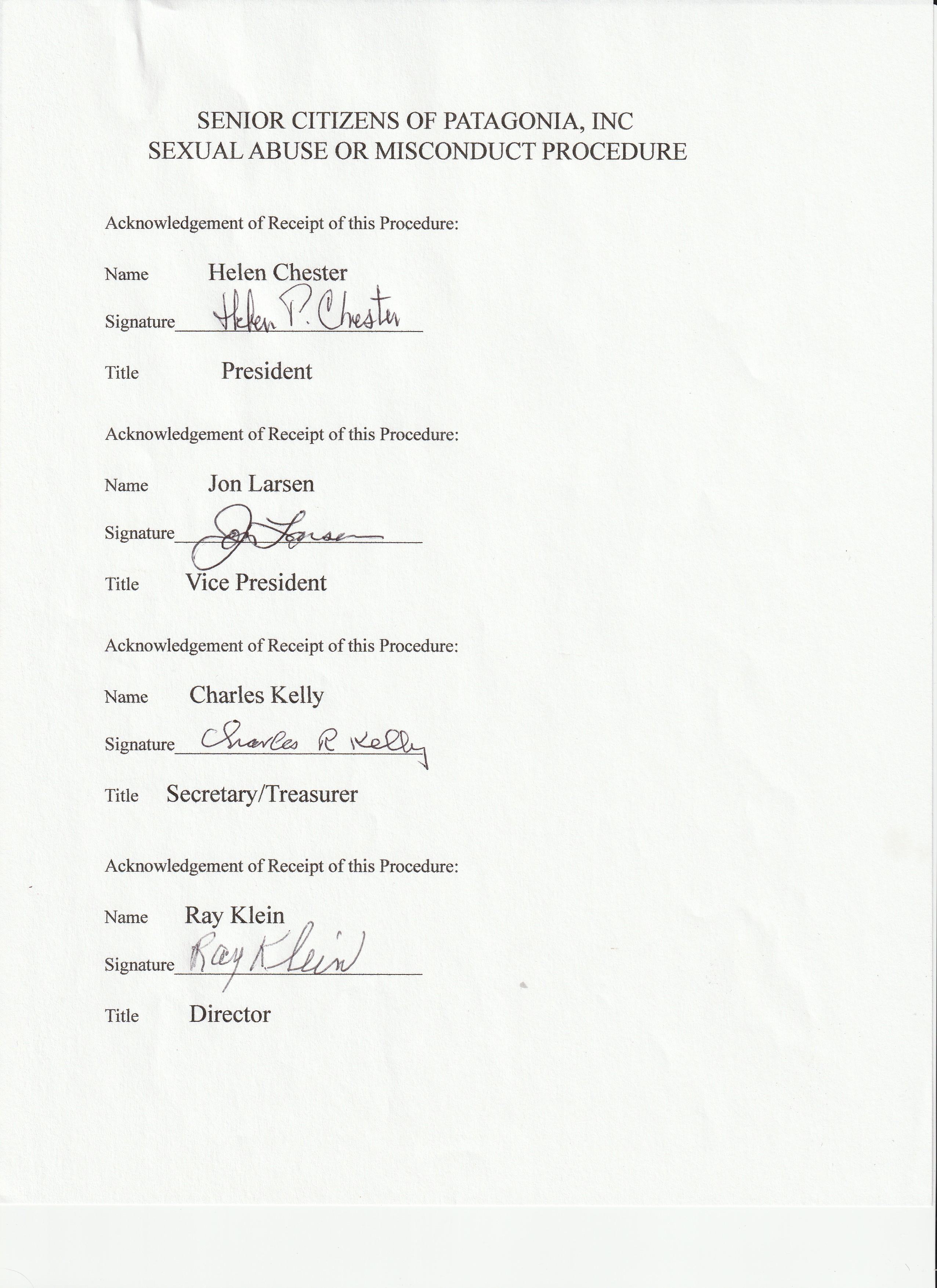
Senior Citizens of Patagonia, Inc. does not tolerate sexual abuse or misconduct in the workplace or during any organization-related activity. Senior Citizens of Patagonia, Inc. provides procedures for employees, volunteers, Board members or any victims of sexual abuse or misconduct to report such acts. Those reasonably suspected or believed to have committed sexual abuse or misconduct will be appropriately disciplined, up to and including termination of employment or membership, as well as criminally prosecuted.
Senior Citizens of Patagonia recognizes that individuals who are seniors or have disabilities are at higher risk of abuse, neglect, and exploitation. According to the National Center on Elder Abuse, approximately 30 percent of individuals with disabilities have experienced some form of mistreatment. The National Council on Aging estimates that one in 10 Americans who are 60 years or older experienced some form of abuse.
Sexual abuse or misconduct may include, but is not limited to:
Physical Abuse or misconduct may include:
Emotional Abuse or misconduct may include:
Exploitation or misconduct may include:
Neglect or misconduct may include:
Abandonment or misconduct may include:
Abusers can be anyone: a family member, a friend, a stranger, a service provider, or a neighbor. It is important, therefore, to be informed and on the lookout for the warning signs of abuse, neglect, and exploitation.
Warning signs of abuse include:
Warning signs of neglect include:
Warning signs of exploitation include:
If you suspect that a person may be experiencing abuse, exploitation, or neglect:
Reporting Procedure
It is the purpose and intent of Senior Citizens of Patagonia, Inc. to provide a safe, secure environment for all members and for those serviced by our organization.
Anyone who learns of sexual abuse or misconduct being committed upon those associated with or serviced by Senior Citizens of Patagonia, Inc. must immediately report it to two (or more) members of the Board of Directors.
Senior Citizens of Patagonia, Inc. will consult with its legal counsel to determine state, federal or other jurisdictional requirements to report suspicions or allegations of sexual or physical abuse or neglect. It will also notify its insurance carrier to seek advice in handling the matter.
Senior Citizens of Patagonia, Inc. is committed to following the state and federal legal requirements for reporting allegations or incidents of sexual abuse or misconduct to appropriate law enforcement and Adult Protective Services Agency.
Senior Citizens of Patagonia, Inc. prohibits retaliation made against any employee, volunteer, Board member, or other person who lodges a good faith complaint of sexual abuse or misconduct.
Investigation and Follow-up
Senior Citizens of Patagonia Inc. will provide information to abuse victims to obtain assistance and counseling options.
Senior Citizens of Patagonia, Inc. will cooperate fully with any investigation conducted by law enforcement or other regulatory/protective services agencies and will make every effort to keep the matters involved in the allegation as confidential as possible.
Any employee, Board member or volunteer who is suspected of, or reported as, engaging in inappropriate sexual activity, misconduct, or relationships with a service recipient, will be immediately suspended, pending the outcome of an investigation into the allegations of abuse.
Employee and Board Member Screening and Selection
As part of its sexual abuse and misconduct prevention program, Senior Citizens of Patagonia, Inc. is committed to maintaining a diligent screening program for prospective and existing employees, volunteers, Board members and others that may have interaction with those serviced by our organization.
Senior Citizens of Patagonia, Inc. may utilize a variety of methods of screening and selection, including applications, personal interviews, criminal background checks and personal and professional references.
All full-time employees and Board members will receive a criminal background check and a Level One Fingerprint Clearance Card from the Arizona Department of Public Safety.
Do you need a ride to a doctor’s or dentist’s appointment? Are you going on a trip by air and don’t want to leave your car at the airport? Need to do shopping but have no way to get to the store?
Senior Citizens of Patagonia has a program to meet some of the transportation needs of seniors and disabled individuals in the Eastern Santa Cruz County communities of Patagonia, Sonoita, Elgin and Canelo. We provide transportation in our three vans, one wheelchair lift equipped, to Nogales, Sierra Vista, Green Valley and Tucson.
All our drivers are volunteers and may not be available on certain days. However, we will try as much as possible to accommodate everyone’s needs.
If you or someone you know may be interested in being a volunteer driver, please call the Patagonia Senior Center.
The Center’s phone number is 520-394-2494 for reservations and details.
Amazon.com has a program called Amazon Smile to donate a portion of your purchases online to charitable organizations and Senior Citizens of Patagonia is on the list of organizations eligible to receive donations.
Basically Amazon donates 0.5% of the purchase price to 501(c)(3) charitable organizations and you can select Senior Citizens of Patagonia from the list of eligible organizations. Do your shopping and ordering at https://smile.amazon.com instead of Amazon.com. For more information go to http://smile.amazon.com/about
Senior Citizens of Patagonia needs volunteer drivers to transport seniors and people with disabilities from the Patagonia, Sonoita, Elgin and Canelo areas to hospitals, medical and dental appointments, and shopping.
There are four vans, three stationed at Patagonia’s garden apartments and one at the Sonoita fire department.
Ordinary driver’s licenses and a good driving record are required.
If interested, please leave your name and phone number at the Patagonia Senior Center (394-2494).
We will return your call promptly.
Welcome to the Senior Citizens of Patagonia, Inc website. We provide services for seniors and disabled individuals in rural Santa Cruz County, Arizona. This site will highlight our transportation program and our senior lunch program. We look forward to your visits to our site.
Our current Board of Directors are:
Helen Chester, President; Jon Larsen, Vice President; Chuck Kelly, Secretary/Treasurer; Philip Brister; Ray Klein; Juan Urias; Maggie DeVries; Patra Kelly
 SENIOR CITIZENS OF PATAGONIA, INC.